Ipv4 vs ipv6 ipv4 vs ipv6 becomes easier to understand when you connect each term to one job in the network. Internet addressing can look complicated because several layers operate at once, but most everyday questions become manageable when you separate local addressing, routing, name resolution, and security.
This guide explains IPv4 vs IPv6 with practical examples for home users, students, website owners, and people troubleshooting devices. The goal is to help you recognize the important values, avoid common mistakes, and know what to verify before changing a configuration.
IPv4 vs IPv6 starts with address size
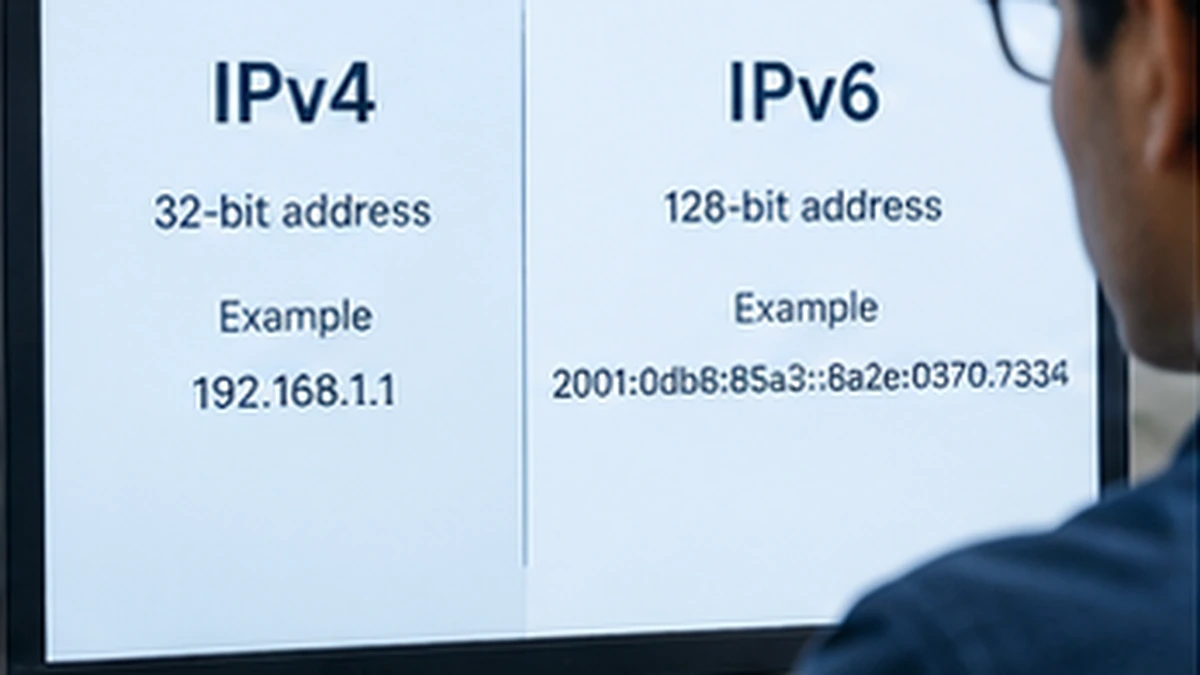
IPv4 uses 32-bit addresses, while IPv6 uses 128-bit addresses. The larger IPv6 address space was designed to provide vastly more unique addresses and to serve as the successor to IPv4.
Apply this section to one real network you use. Identify the exact setting, address, or record involved and write what job it performs before you consider changing it.
How IPv4 addresses are written
IPv4 addresses are normally written as four decimal numbers separated by dots, such as 192.0.2.10. Prefix length or subnet information determines which part represents the network.
Separate observation from assumption here. Record the value you can actually see, then decide what extra test would be needed before blaming that value for a connectivity problem.
How IPv6 addresses are written
IPv6 addresses are written as hexadecimal groups separated by colons. IPv6 notation allows leading zeros and runs of zero groups to be compressed, which makes long addresses easier to read.
Keep local and Internet-facing context separate. The same number can be meaningful inside one network while being irrelevant or unreachable from another network.
Why IPv6 was created
IPv4 address space is limited. IPv6 expands the address space and updates the protocol for continued Internet growth. It is a separate protocol version rather than simply a longer form of IPv4.
If you are troubleshooting, change only one setting after saving the current value. Networking problems become harder to diagnose when several variables move at the same time.
Can IPv4 and IPv6 work together
Yes. Many networks run dual stack, which means devices and services support both protocols. The protocol used for a connection depends on device support, network configuration, DNS answers, and the destination service.
Use this concept as a decision point rather than a vocabulary exercise. Ask which screen, command, DNS record, or router page would provide evidence about this part of the path.
DNS records for IPv4 and IPv6
DNS A records normally contain IPv4 addresses, while AAAA records contain IPv6 addresses. A domain can publish both so compatible clients can choose an available path.
Remember that convenience and security are different goals. A configuration can make access easier while creating exposure, so verify the security effect separately.
Does IPv6 automatically improve security
No. IPv6 does not remove the need for firewalls, authentication, encryption, software updates, and correct configuration. Security depends on controls and implementation, not on address length alone.
When another device is available, compare it with the affected device. A working control device can quickly show whether the problem is local or network-wide.
What ordinary users should do
Most users do not need to choose IPv4 or IPv6 manually. Keep devices and routers updated, and let the network provider and operating system handle protocol selection unless there is a specific technical requirement.
Finish by explaining this idea in one sentence without jargon. If the explanation is still unclear, return to the practical example before moving to more advanced settings.
Why the transition takes a long time
IPv4 remains widely used, so networks rely on NAT and other techniques while IPv6 deployment continues. The transition is gradual because applications, providers, routers, and devices all need compatible support.
Why settings often show both protocols
Modern systems commonly configure IPv4 and IPv6 at the same time. Seeing both does not mean the Internet connection is duplicated; the operating system selects an appropriate protocol for each destination.
A practical networking example
Imagine a device that appears connected but cannot reach the expected service. Instead of changing random settings, the user identifies the local IP information, checks the gateway, tests whether an Internet address is reachable, and then checks DNS. This layered approach shows where IPv4 vs IPv6 fits into the path and keeps one symptom from being mistaken for the whole problem.
Connect this topic to the rest of your IP knowledge
Read what an IP address is for one related concept, and use A and AAAA DNS records when you need a second piece of the same networking picture.
These links point to other posts in this same first batch. Once all ten posts are published, the site will work as a connected beginner reference rather than as isolated articles.
A seven-day learning plan for IPv4 vs IPv6
Day 1: identify the relevant values on one real device. Day 2: mark which values are local and which are Internet-facing. Day 3: review the router or DNS configuration without changing it. Day 4: perform one safe lookup or connectivity test. Day 5: compare the result with a second device or network. Day 6: write a short explanation in your own words. Day 7: repeat the check without notes and correct any misunderstanding. In this article, apply that point specifically to IPv4 vs IPv6 and the network you are actually using.
You can compress the plan into one afternoon if you already understand networking, or spread it across several weeks if the concepts are new. Practical repetition matters more than speed.
Quick checklist
- Key purpose of IPv4 vs IPv6 identified
- Local and public context separated
- Current values saved before changes
- DNS and routing roles kept separate
- Security assumptions checked
- One practical test completed
Use the checklist as a learning and troubleshooting aid. The goal is to understand IPv4 vs IPv6 well enough to explain what each value does and to know which part of the network to check next.
Frequently Asked Questions
Do I need advanced networking knowledge to understand IPv4 vs IPv6?
No. Start with the basic purpose of each value and use one real device or router as the example. Advanced routing and subnet design can come later.
Can I copy IP settings from another device?
Usually no. Devices need values that fit the actual network, and copying a manual address can create conflicts. Use DHCP unless you have a clear reason to configure an address manually.
Does an IP address identify a person?
Not reliably by itself. Addresses can be shared, changed, translated, or routed through VPNs. Identity requires stronger evidence than one network address.
Should I change DNS or IP settings whenever the Internet feels slow?
No. Slow performance can come from Wi-Fi quality, congestion, routing, the remote service, or the ISP. Change network settings only when the symptoms and tests support that decision.
How to review your understanding of IPv4 vs IPv6
Open the relevant settings, DNS view, or router page and identify the values without changing them. Explain what each value controls, whether it is local or public, and what symptom you would expect if it were wrong. This turns IPv4 vs IPv6 from a definition into a troubleshooting skill.
Then compare your explanation with the technical reference and correct any gap. Keep a short note with the terms you confused most often so the next network problem starts with a clearer mental model.
Why IPv4 scarcity changed network design
Limited IPv4 space encouraged widespread address sharing and NAT. These techniques helped extend IPv4 use, but they also added layers between devices and the public Internet that can complicate inbound connectivity.
Use a real device as the reference for this point. Write the current address, record, or route exactly as it appears, then explain what would change if the value were wrong. This turns the concept into a concrete diagnostic step instead of a definition you only memorize. For IPv4 vs IPv6, keep the example tied to the actual network or service you are testing.
IPv6 reduces the need for address sharing
IPv6 provides enough address space for globally unique addressing at enormous scale. Network policy and firewalls are still important, but the design does not depend on IPv4-style address conservation in the same way.
Compare the same setting on a second device or network when possible. A difference does not automatically mean one is wrong, but the comparison can reveal which values are supplied by the local router, provider, VPN, or DNS service. For IPv4 vs IPv6, keep the example tied to the actual network or service you are testing.
IPv6 has different local address concepts
IPv6 includes address scopes and special address types that do not map perfectly to familiar IPv4 private-address habits. Users should avoid assuming that every IPv6 address behaves like a 192.168.x.x address.
Before changing configuration, save the current value and the time of the test. Networking problems can be temporary, so a small record helps separate a persistent configuration issue from a short outage or changing provider condition. For IPv4 vs IPv6, keep the example tied to the actual network or service you are testing.
Why some websites prefer one protocol
A client may try IPv6 and IPv4 in parallel or according to operating-system logic. If one path has better routing or fewer problems, the user can experience different performance even when both addresses reach the same service.
Try to predict the symptom before running the test. If your prediction is wrong, update your mental model instead of changing more settings. This habit makes network troubleshooting more reliable and reduces trial-and-error changes. For IPv4 vs IPv6, keep the example tied to the actual network or service you are testing.
How to test protocol-specific problems
When troubleshooting, compare A and AAAA DNS answers and test the service over each protocol separately if your tools allow it. This can reveal whether the problem is general or limited to one address family.
Finish this step by explaining the result without jargon to someone who does not manage networks. If you can describe what the value controls, where it is valid, and what it cannot prove, you probably understand the concept well enough to use it safely. For IPv4 vs IPv6, keep the example tied to the actual network or service you are testing.
Authoritative resource to review
For a technical reference related to this topic, review IETF RFC 8200 – IPv6 Specification. Use your device manufacturer, ISP, hosting provider, or network administrator for configuration details that are specific to your environment.
Final perspective
Ipv4 vs ipv6 becomes much less confusing when each value is connected to one job: identifying an interface, deciding what is local, finding the next router, translating a name, or protecting a connection. Learn the role first, then learn the syntax and tools. That order makes troubleshooting faster and reduces the chance of changing the wrong setting.
Leave a Reply